Writer: David Gray
Performer: David Gray
Country of Origin: U.K.
Let’s begin with a little disclaimer:
Where David Gray is concerned, I’m possessed of an inordinate degree of bias. I discovered Gray’s music in the summer of 2001. I was perusing the DVD section at a music & movie store in Halifax, Nova Scotia when ‘Sail Away’ began playing over the store’s sound system. I had never heard anything quite like this song. It was – in my humble opinion – the most perfect fusion of pop, folk, and electronic music I had ever experienced. And I was hooked for life.
Today, I’m perfectly happy to admit that he’s my all-time favourite musical artist.
Ok, now that that’s out of the way, let’s talk about the sublime ‘Birds of the High Arctic’.
This tune appeared on Gray’s tenth studio album, Mutineers, released in 2014.

One of the really interesting things about this album – aside from how good it is lol – is that ‘Birds of the High Arctic’ is just one of three bird-related titles. There’s also ‘As the Crow Flies’ and ‘Gulls’, both of which I’ll probably get into in future posts.
If you’re unfamiliar with Gray’s music – and I assume you are – then you might be interested to know that his entire musical catalog is punctuated with bird references. Not to mention references to nature in general. Gray is an avowed lover of the natural world, and he’s especially fond of birds. So it’s not all that surprising that his music is so nature- and bird-centric.
I’ll circle back to this topic in a bit, though. Right now I want to dig into what ‘Birds of the High Arctic’ is about.
Here’s the first verse:
Baby say it isn’t true
You were never there
It wasn’t you
It’s more than I can do
To try and keep it shiny new
The gap just opens up
Between the words we like to use
And the thing that’s seen
Seen through your eyes now darling
In blue distances calling
Like the birds of the high arctic
Before reading on, I’d recommend giving the full song a listen. As provocative as the lyrics are, they represent only a fraction of what makes this song so achingly beautiful. There are several live versions of the song floating around, all of which are quite excellent, but I’d stick with the original album version for the time being.
Here’s an audio-only YouTube link. Crank it!
So what exactly is this song about?
Actually, wait. That’s the wrong question.
How about:
What is my personal interpretation of the song?
Yeah, that sounds sooo much better. There are no right or wrong answers when you frame it that way. Which is precisely the way it works with all great art.
To begin – because I think this is key – who are the birds of the high Arctic? You know, we aren’t talking Panama here. Or the wilds of Africa. We’re talking about the earth’s upper latitudes. Where it tends to be fairly cold and icy year-round. And where birds are generally few and far between.
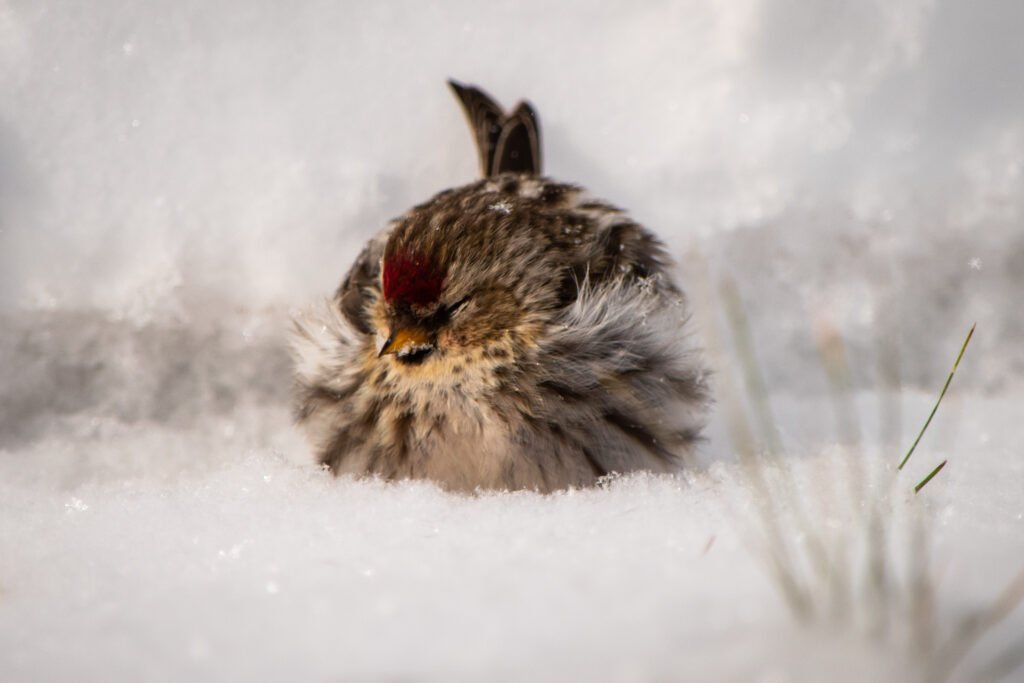
There are plenty of avian species that spend at least part of year in the Arctic. Redpolls and Dark-eyed Juncos are two fine examples. But there are only a handful of birds that we tend to associate almost exclusively with the Arctic. The Rock Ptarmigan and Snowy Owl are perhaps the two best-known. There’s also the Snow Bunting, Ivory Gull, Arctic Tern, Black Guillemot, Gyrfalcon, and a few others.
The birds of the Arctic are a quiet and unassuming lot. Whether they’re prey or a predator, they aren’t trying to grab anyone’s attention. Remaining as inconspicuous as possible is kind of their thing. You might hear them occasionally – if you try really hard – but spotting one across the endless fields of snow and ice will always be something of a challenge.
Which is where I think Gray is coming from when he writes In blue distances calling/Like the birds of the high arctic. The metaphor is meant to emphasize the distance (i.e. the gap that has opened up) between the song’s protagonist and their significant other. The lyrics seem to suggest that said protagonist has inadvertently discovered that their partner has perhaps been unfaithful.
The third verse…
They’re calling
Like the birds of the high arctic
This darling
For the light in your eyes sparked it
Two sheets to the wind
…adds another layer to the song’s themes.
I’m not aware of any metaphorical meaning behind ‘two sheets to the wind’ other than describing someone who is moderately drunk. A quick Google search turned up no heretofore unknown uses of the expression.
I don’t think the metaphorical meaning makes a whole lot of sense in the context of the song, anyway. I would argue that Gray is borrowing the original literal meaning of the phrase and using it to illustrate a state of being. Here’s how Dictionary.com explains the nautical origin of the phrase:
‘The sheet is the line that controls the sails on a ship. If the line is not secured, the sail flops in the wind, and the ship loses headway and control.’
That totally tracks with the rest of the song’s lyrics. Thematically, I believe Gray is ultimately describing a relationship that has disintegrated. Or one that has veered very far off course. The protagonist is left feeling lost and disoriented.
And the sound of birds calling across the lonely, desolate, and blue-tinted Arctic landscape? It perfectly describes the sense of distance and disconnection that has consumed the couple.
Well, that’s my take on it. Maybe I’m wrong. Or maybe I’m right. Who can say for sure? Maybe the birds of the high Arctic.
Ok, one last thing. I said I’d get back to this – Gray’s relationship with nature – so here it is.
Based solely on social media posts he’s made over the years, I kind of knew all this. However, I hadn’t come across any official statements he’s made on the topic until very recently. This is from a piece that appeared in an April 2025 edition of the UK’s The Telegraph. He’s referring here to going for walks when he has downtime:
“I want to hear the nature around me and be completely connected. I’m so wired to nature it’s a time when I’m very present. I’m very in the moment. I’m living the landscape, the birds, the calls, the place, the sound of the wind through the grass, the water. The whole thing is living inside me.”
It’s a little bit astonishing to read that. It could just as easily have come out of my own mouth. It’s really no wonder that I’m so drawn to his music.
Cheers all!
P.S. Here’s one of those occasional birds of the Arctic, a Redpoll: